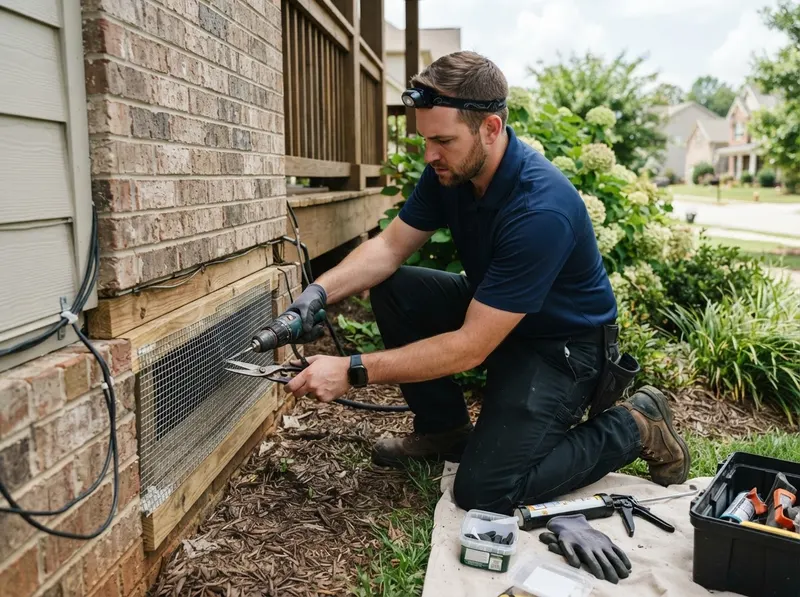
Older architecture throughout Overbrook, Alta Vista, and Augusta Road features vented soffits, crawl space louvers, and stacked brick foundations that permit entry to roof rats and field mice. Invasive species like the brown rat navigate downspouts and dense mature landscaping common to North Main and Botany Woods to nest in fiberglass attic batting. Structural abatement differs from recurring chemical application by permanently closing entry portals rather than treating existing vermin indefinitely. Standard treatment uses non-corrosive metals, silicone expanding foams, and cementitious plugs along pipe penetrations, whereas basic extermination leaves entry routes open for autumn migrations. While chemical-only measures reduce surface populations temporarily, they leave open structural entries that encourage re-infestation each winter when regional temperatures across the Piedmont plateau fall beneath 45 degrees Fahrenheit.
Technicians examine building elevations from rooflines down to footer perimeters, locating gaps around HVAC chase lines, louvered crawl space vents, and garage threshold gaskets. Construction standards outlined by the International Code Council mandate continuous foundation ventilation, which technicians protect using rust-resistant 19-gauge hardware cloth screen rather than solid blocking to preserve home airflow. Interior attic insulation inspections frequently identify compressed nesting sites, fecal pellets, and gnawed electrical casings that pose secondary fire hazards documented by the National Fire Protection Association. Population abatement occurs inside mechanical zones utilizing tamper-resistant bait depots and mechanical traps deployed under safety guidelines established by the Environmental Protection Agency to prevent accidental exposure to pets or wildlife.
1. Technicians survey every crawlspace vent, gable opening, and masonry expansion joint across the property.
2. Workers install structural mesh backing and apply exterior architectural sealants formulated to withstand high humidity levels in Upstate South Carolina.
3. The team deploys interior target stations within dead spaces and non-living mechanical rooms for complete extraction.
4. Field specialists return on days 7 and 14 to verify rodent-free monitoring indicators and remove internal abatement traps.
Property size and foundation architecture dictate material quantities and access configurations. Residences along Gower Estates and Parkins Mill built over damp, soil-floor crawl spaces require perimeter vapor containment barriers combined with structural door sweep replacements, whereas slab constructions in the West End often face access issues along stucco drip screeds. In Nicholtown, close-quarter tree lines require secondary trimming clearances to deter rodent roof access according to standards maintained by the International Society of Arboriculture. Work follows established wildlife containment rules published by the South Carolina Department of Natural Resources, ensuring non-target wildlife like flying squirrels are excluded without lethal disruption. GoldenMeadow Pest Defense sets minimum service pricing starting at $300 to ensure commercial-grade exterior sealants, fasteners, and heavy hardware cloth are utilized for long-term structural exclusion.