Subterranean ant colonies in Greenville County exploit the transition zones between damp hardwood mulch beds, red clay substrata, and home foundations. According to research from the Clemson University Cooperative Extension, Argentine ants (Linepithema humile) and odorous house ants (Tapinoma sessile) form supercolonies containing dozens of reproductive queens across contiguous properties. Standard over-the-counter pyrethroid sprays trigger colony budding, an instinctive defensive mechanism where workers divide satellite broods and disperse deeper into wall framing, plumbing pipe chases, and subflooring. GoldenMeadow Pest Defense counteracts this biological behavior by deploying slow-acting non-repellent active ingredients such as fipronil and dinotefuran. These materials allow foraging worker ants to contact the liquid barrier without detection, grooming the chemistry through trophallaxis directly into the heart of the subterranean reproductive chamber as outlined by the EPA Safe Pest Control guidance.
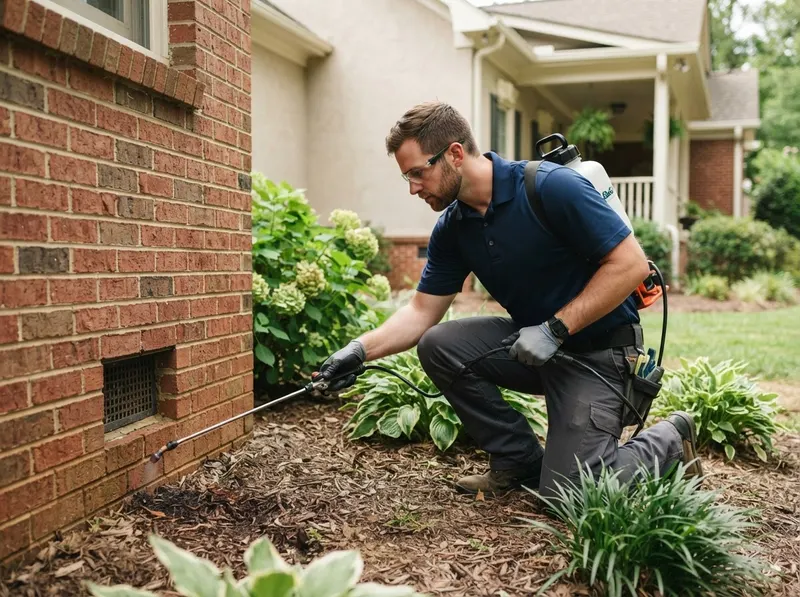
Exterior treatments require continuous liquid barrier bands applied three feet up the brick or siding surface and three feet out across adjacent turf or soil, adhering to standards from the National Pest Management Association. In established neighborhoods such as North Main and Augusta Road, mature oak canopies deposit organic leaf litter against foundation perimeters, elevating relative humidity above 75% and accelerating colony expansion. The South Carolina Department of Public Health emphasizes moisture management around footings to mitigate secondary insect vectors. Older crawlspace framing in Overbrook and West End requires supplementary dry boric acid dusting into foundation penetrations, expansion joints, and open mortar vents. By comparison, modern slab-on-grade architecture in Parkins Mill and Gower Estates channels foraging workers through window weep holes and garage door expansion seals, requiring micro-encapsulated formulations designed for prolonged UV resistance under guidelines from the ASTM International Committee on Environmental Evaluation.
Properties bordering natural corridors like the Swamp Rabbit Trail, Cleveland Park, and the Reedy River corridor near Alta Vista contend with elevated pressure from wood-destroying black carpenter ants (Camponotus pennsylvanicus). Guidelines documented by the USDA Forest Service Forest Health Protection confirm carpenter ants excavate galleries through water-damaged structural timbers rather than consuming cellulose directly. If a homeowner discovers localized frass or isolated trailing along kitchen countertops, target-specific carbohydrate and protein baits resolve the initial intrusion, whereas structural perimeter trenching is necessary if workers establish interconnected satellite nests along the outer perimeter sill. The mechanical trade-off between exterior bait stations and continuous liquid perimeter bands is longevity versus immediate suppression: liquid non-repellent barriers provide 90 days of continuous boundary protection, whereas bait placements require active replenishment every 30 days during peak summer heat.
Severe infestations near the foothill transitions of Paris Mountain State Park and eastern developments like Botany Woods and Nicholtown require integrated approach sequencing. Technicians follow protocols aligned with the Occupational Safety and Health Administration job safety measures and National Institute of Standards and Technology calibrated application rates, spraying exterior ground bands with 0.06% active concentrations at a volume of 4 gallons per 1,000 square feet. Structural landscape elements including untreated pine straw mulch, stacked firewood, and stone retaining walls must be mechanically cleared 12 inches away from perimeter walls to eliminate subterranean thermal bridges. Chemical barriers maintain compliance with structural pest regulations overseen by the South Carolina Department of Agriculture, guaranteeing that localized populations are dismantled at the colony source rather than temporarily detoured across interior drywall perimeters.